Start Chat

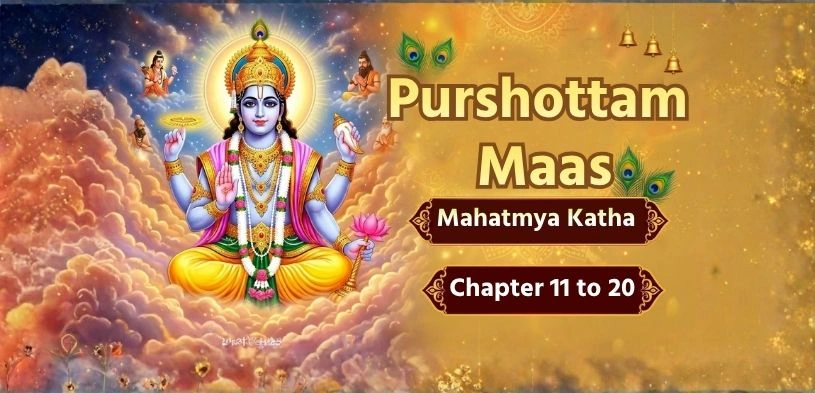
In the sacred traditions of Sanatan Dharma, Purushottam Maas holds an exceptionally exalted and auspicious place. This holy month is considered a rare opportunity to receive the special grace of Lord Shri Hari.

The chanting, penance, charity, and fasting performed during this divine period purify a devotee’s life and lead them toward both material prosperity and spiritual upliftment.

So far, in Purushottam Maas Chapters 1 to 10, you learned about the glory of it, its origin, and many wondrous incidents reflecting the compassion of the Lord. Now, in Chapters 11 to 20, even deeper spiritual truths, inspiring incidents, and the lofty ideals of devotion, righteousness, and austerity are beautifully described.

With faith and devotion, immerse yourself in the divine episodes of Chapters 11 to 20 of the Purushottam Maas Mahatmya Katha and draw inspiration to make your life righteous and virtuous.


Purushottam Maas Mahatmya Katha: Chapter 11

Sutaji said, “O great sages! Now I shall narrate the essence of a wonderful story that reveals the severe penance of a devoted maiden, the grace of Lord Shiva, and the profound glory of Purushottam Maas.”

When Naradji inquired, Lord Narayan replied.

Once, the daughter of a sage desired Lord Shiva as her husband and undertook extremely difficult penance. She was firm in determination and unmatched in patience. During summer, she sat amidst five blazing fires; during winter, she stood in freezing water; and during the rainy season, she remained beneath the open sky without shelter. She performed austerities for thousands of years, her body becoming weak and frail, yet her devotion remained unwavering.

Even Indra, the king of the gods, became anxious upon witnessing her severe penance, but the maiden never lost focus from her goal. Finally, pleased by her devotion, Lord Shiva appeared before her in his divine form. Overwhelmed with joy, she bowed respectfully and praised him as the destroyer of sorrow and protector of devotees.

Lord Shiva said, “O devoted maiden! I am pleased with you. Ask for any boon you desire.”

Filled with excitement, she repeatedly requested, “O Lord! Grant me a husband, grant me a husband.” She repeated this wish five times.

Smiling gently, Lord Shiva replied, “O beautiful one! Since you have asked five times, in your next birth you shall have five husbands. All of them will be heroic, righteous, and virtuous.”

Hearing this, the maiden became distressed. Folding her hands, she said, “O Lord! In this world, a woman has only one husband. Five husbands would go against worldly customs. Please do not grant me such a boon.”

Lord Shiva then spoke seriously, “O maiden! This is the result of your past karma. In a previous birth, you insulted Sage Durvasa and disrespected Purushottam Maas. Therefore, you must bear this consequence. In this birth, you will not enjoy marital happiness, but in your next birth you will be born miraculously, enjoy the companionship of five husbands, and ultimately attain liberation.”

He further explained the greatness of Purushottam Maas, saying that those who observe it faithfully attain happiness, prosperity, and salvation, while those who disrespect it face suffering.

After saying this, Lord Shiva disappeared. The maiden was left grief-stricken and lonely, like a deer separated from its herd.

Sutaji concluded that this story teaches us that devotion and penance always bear fruit, but understanding and honoring the sacredness of Purushottam Maas is equally essential.


Purushottam Maas Mahatmya Katha: Chapter 12 

Sutaji said, “O noble sages! Now hear the story describing the next birth of that ascetic maiden as Draupadi and the immense influence of Purushottam Maas.”

Naradji asked, “O Lord! What happened to the maiden after Lord Shiva disappeared?”

Lord Narayan replied that King Yudhishthir once asked the same question to Lord Krishna, and he would now narrate that conversation.

Lord Krishna said:

After Lord Shiva departed, the maiden became overwhelmed with sorrow and fear. Her body was already weakened from austerities, and now grief consumed her further. Eventually, she gave up her life in her hermitage.

At that time, King Yajnasena performed a grand sacrifice, and from the sacrificial fire emerged a radiant maiden. She later became famous as Draupadi, the daughter of King Drupad. The ascetic maiden had now been reborn as Draupadi.

At her swayamvar, Arjuna won her by piercing the eye of a revolving fish. However, she later suffered immense humiliation in the Kaurava court when Dushasan dragged her by the hair. In desperation, she cried out to Lord Krishna for protection.

Krishna explained that he did not immediately respond to her first call because she had once disrespected Purushottam Maas. But when she surrendered completely with pure devotion, he instantly protected her honor.

Lord Krishna further said that even though Draupadi was his beloved devotee, disrespect toward Purushottam Maas caused her suffering. Those who insult devotees become enemies of the Lord himself.

He assured the Pandavas that their enemies would be destroyed and instructed them to faithfully observe Purushottam Maas. Later, after years of exile and devotion, the Pandavas regained their kingdom through Krishna’s grace.

Sutaji concluded that the greatness of Purushottam Maas is beyond comprehension and only fully known to the Lord himself.


Purushottam Maas Mahatmya Katha: Chapter 13 

Sutaji narrated the story of the righteous King Dridhadhanva, his prosperity, and the awakening of detachment within his heart.

Lord Narayan explained that in the kingdom of Haihaya lived a noble king named Chitradharma, whose son Dridhadhanva was truthful, wise, brave, and virtuous. After studying the scriptures under his guru, Dridhadhanva returned home and later inherited the kingdom when his father renounced worldly life and went to the forest for penance.

King Dridhadhanva ruled wisely and justly. His queen, Gunasundari, was beautiful and devoted, and together they had four sons and a daughter.

Despite his wealth and success, one night the king wondered how he had attained such prosperity without performing great penance or sacrifices. Disturbed by this thought, he later wandered into a forest during a hunt and rested beneath a banyan tree.

There, a mysterious parrot repeatedly recited a profound verse:

“O man! If you remain attached to fleeting worldly pleasures and fail to contemplate the soul, how will you ever cross the ocean of worldly existence?”

The king became deeply affected by these words and returned home filled with detachment and silence. He stopped speaking and eating, causing great concern to Queen Gunasundari, who could not understand the reason for his sorrow.


Purushottam Maas Mahatmya Katha: Chapter 14 

Lord Narayan continued:

While King Dridhadhanva remained absorbed in contemplation, Sage Valmiki arrived at his palace. The king welcomed him with utmost reverence, washed his feet, and praised his arrival as a blessing.

Valmiki asked the king why he appeared troubled. The king then narrated the mysterious words spoken by the parrot and asked how he had attained such wealth and power.

Meditating upon the king’s previous birth, Sage Valmiki revealed that he had once been a pious Brahmin named Sudev living on the banks of the Tamraparni River in South India. His wife, Gautami, was equally virtuous, but the couple remained childless and deeply sorrowful because of it.

At Gautami’s suggestion, they both performed severe penance and worshipped Lord Vishnu for thousands of years. Pleased with their devotion, Lord Vishnu finally appeared before them.


Purushottam Maas Mahatmya Katha: Chapter 15 

Overwhelmed by the Lord’s presence, Sudev offered heartfelt prayers and requested a worthy son as a boon.

Lord Vishnu replied that according to destiny, Sudev was not meant to have a child for seven lifetimes and advised him to ask for another boon instead.

Heartbroken, Sudev collapsed in despair while Gautami tried to console him. Witnessing their sorrow, Garuda became compassionate and pleaded with Lord Vishnu to bless the devoted couple with a son.

Pleased with Garuda’s devotion, Lord Vishnu agreed, and Garuda granted them a son through his divine grace.


Purushottam Maas Mahatmya Katha: Chapter 16 

Garuda warned Sudev that although the child was being granted through divine grace, he would bring both joy and sorrow.

In time, Gautami gave birth to a radiant son named Shukdev. He grew into a brilliant scholar and mastered sacred knowledge at an early age.

One day, Sage Deval visited their home and blessed the child but also revealed a painful truth: Shukdev would die by drowning at the age of twelve.

Sudev and Gautami were devastated, but Gautami encouraged her husband to surrender to the will of God and continue remembering Lord Hari.


Purushottam Maas Mahatmya Katha: Chapter 17 

One day, Sudev went to the forest while his son Shukdev played near a stepwell with friends. During their games, Shukdev dived into deep water and tragically drowned.

When the children informed Gautami, she fainted in grief. Sudev also collapsed upon hearing the news.

The grieving parents reached the stepwell and cried bitterly over their son’s lifeless body. Sudev lamented helplessly, calling upon Lord Vishnu to rescue him from the unbearable agony of losing his child.


Purushottam Maas Mahatmya Katha: Chapter 18 

While Sudev mourned continuously, fierce storms and heavy rains covered the land for an entire month. Lost in grief, Sudev unknowingly observed the vows of Purushottam Maas — fasting, bathing repeatedly in rainwater, and renouncing worldly comforts.

Pleased by this unintentional observance, Lord Krishna appeared before him and revived Shukdev, blessing him with a lifespan of twelve thousand years.

The Lord explained that even unknowingly observing Purushottam Maas can produce miraculous spiritual results. He further revealed that in a future birth, Sudev would be reborn as King Dridhadhanva, Gautami as Queen Gunasundari, and Shukdev would later appear as the wise parrot who inspired the king toward renunciation.


Purushottam Maas Mahatmya Katha: Chapter 19 

Naradji asked Lord Vishnu how Purushottam Maas possessed such extraordinary power.

Lord Vishnu explained that Sudev unknowingly performed all the sacred practices of the holy month:

  • His fasting became a sacred vow.
  • The constant rains became ritual bathing.
  • His detachment from worldly life became penance.

The Lord declared that even observing Purushottam Maas for a single day can destroy countless sins. Deeply moved by this realization, Sudev dedicated the rest of his life to sincere devotion, worship, charity, and remembrance of Lord Vishnu.

After living righteously for many years, Sudev and Gautami attained Vishnu Lok and were later reborn as King Dridhadhanva and Queen Gunasundari.


Purushottam Maas Mahatmya Katha: Chapter 20 

Naradji remained eager to know how one should properly observe Purushottam Maas.

Lord Narayan explained that King Dridhadhanva humbly requested Sage Valmiki to teach him the correct method of observing the sacred month.

Sage Valmiki instructed:

  • Wake up during Brahma Muhurta.
  • Maintain purity and complete daily rituals properly.
  • Bathe, wear clean clothes, and apply sacred tilak.
  • Perform prayers, meditation, and Sandhya Vandana.
  • Establish a sacred kalash and worship Lord Purushottam with devotion.
  • Offer sandalwood paste, flowers, lamps, and food offerings.

He emphasized that human life is rare and should be used for righteousness and devotion rather than attachment to temporary pleasures.

Valmiki further explained that wealth, youth, and life itself are temporary, so one should not delay in performing charity and spiritual practices.

He declared that among all months, Purushottam Maas is supreme, just as the Ganga is supreme among rivers. Even simple acts of worship, charity, and remembrance of Lord Vishnu during this month can free a person from great suffering and lead them toward liberation.

Sutaji concluded by saying that whoever listens to or reads these sacred chapters with faith becomes free from sins and attains the divine abode of the Lord.

X
Amount = INR