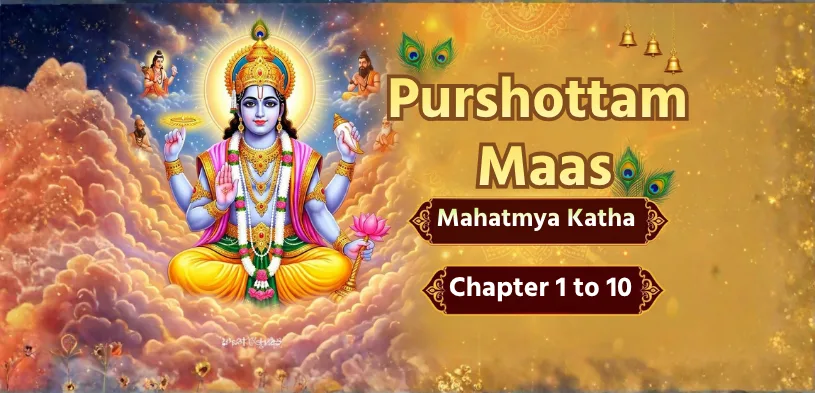
In the divine traditions of Sanatan Dharma, Purushottam Maas holds a unique and extraordinary significance. This sacred month is not merely an additional period in the calendar but is regarded as a symbol of the infinite grace of Lord Shri Hari Vishnu. Whenever imbalance arises in the cycle of time and calculations, this holy month manifests to strengthen the path of Dharma and spiritual practice. Today, we shall explore the glory and essence of the Purushottam Maas Katha from Chapter 1 to Chapter 10.
Purushottam Maas Mahatmya Katha: Chapter 1 (Narrative Summary)
The sacred story begins by offering obeisance to Lord Purushottam, the Lord of Vrindavan, who fulfills all the wishes of devotees. Remembering Lord Narayan, Nar-Narayan, Goddess Saraswati, and Maharishi Vyas, the narration proceeds.
In the holy forest of Naimisharanya, many great sages and saints had gathered. They were masters of the Vedas, ascetics, devoted to Brahman, and dedicated to the welfare of all beings. Their purpose was to perform a great yajna for the upliftment of the world and to attain divine knowledge capable of liberating souls from worldly suffering.
At that time, Soot Ji, the great storyteller and knower of scriptures, arrived there during his pilgrimage. His appearance was radiant and divine. Calm, disciplined, immersed in the name of God, and glowing with spiritual brilliance, he inspired reverence among all.
Seeing him, the sages respectfully stood up, offered him a proper seat, and requested, “O Soot Ji! You are the knower of all scriptures. Kindly narrate to us a story that is full of spiritual essence, beneficial for humanity, and capable of helping souls cross the ocean of worldly existence.”
Pleased by their request, Soot Ji began the narration. He explained that while traveling across sacred pilgrimage sites, he had bathed in holy rivers such as the Ganga, Yamuna, Godavari, Kaveri, and Narmada, and had worshipped the gods and ancestors. These journeys had purified and calmed his mind even further.
During his travels, he reached Hastinapur, where he learned that King Parikshit had renounced his kingdom and was performing penance on the banks of the Ganga. Soot Ji also went there and witnessed an extraordinary gathering of sages, yogis, and ascetics engaged in severe austerities.
At that very moment, a divine event occurred. Shri Shukdev Ji, the enlightened son of Maharishi Vyas, arrived there. Though youthful in appearance, he possessed unparalleled wisdom and detachment. Free from worldly illusion and absorbed in Brahman, his divine presence illuminated the entire assembly.
All the sages rose in respect and seated him on a high seat of honor. Surrounded by saints, Shukdev Ji shone like the moon amidst the stars, while everyone eagerly awaited the nectar of divine wisdom flowing from his lips.
Purushottam Maas Mahatmya Katha: Chapter 2 (Narrative Summary)
Soot Ji said, “O sages! When King Parikshit reached the banks of the Ganga, Lord Shukdev Ji narrated the divine Shrimad Bhagavatam to him. By listening to this sacred discourse, King Parikshit attained liberation.”
Witnessing that divine atmosphere filled with spiritual purity, Soot Ji came to the sages’ yajna. The sages requested him to narrate a story that could bring peace, spiritual upliftment, and liberation.
Soot Ji humbly replied that he would narrate whatever he had heard from his guru, Maharishi Vyas.
He then described an ancient event. Once, Devarshi Narad visited the ashram of Nar-Narayan near Badrinath. The hermitage was filled with divine beauty, greenery, flowering trees, and the sacred waters of the Ganga and Alaknanda.
Narad Muni bowed before Lord Narayan, who was immersed in deep penance. With great devotion, Narad praised Him and said:
“O Lord of the universe! In Kaliyug, living beings are trapped in ignorance and worldly desires. Please reveal a simple and effective path through which they may attain welfare and liberation.”
Pleased by Narad’s compassion for humanity, Lord Narayan said:
“O Narad! I shall reveal a most sacred secret — the glory of Purushottam Maas.”
He explained that Purushottam Maas is extremely holy, and those who observe fasting, chanting, charity, and worship during this month become recipients of divine grace and freedom from suffering.
Narad further asked about the mystery, rules, and spiritual fruits associated with this sacred month. He requested a remedy for the sorrows of the suffering people of the world.
Listening to Narad’s compassionate words, Lord Narayan began narrating the sacred story for the welfare of all beings.
Purushottam Maas Mahatmya Katha: Chapter 3 (Narrative Summary)
The sages requested Soot Ji to explain the secret teachings Lord Narayan had shared with Narad.
Lord Narayan then narrated an ancient incident once told by Lord Krishna to Yudhishthir.
After losing everything in the game of dice, the Pandavas were exiled to the forest. Draupadi was humiliated in the royal court, but Lord Krishna protected her honor.
Living in hardship in Kamyavan, the Pandavas survived on roots and fruits. One day, Lord Krishna visited them along with several sages.
Seeing their miserable condition, Lord Krishna became deeply emotional and furious at the Kauravas. His anger resembled the fire of cosmic destruction. Arjun respectfully pacified Him, reminding Him that the destruction of the entire world for the sins of a few would not be appropriate.
Calmed by Arjun’s humble words, Lord Krishna blessed them. Arjun then asked:
“O Lord! What is the remedy through which human beings can overcome all sorrows?”
Lord Krishna revealed a rare and secret truth. He explained that every element of creation has its presiding deity. Then He narrated the story of an extra lunar month, which had no solar transition (Sankranti). Because of this, people insulted and rejected it, calling it “Mal Maas” (impure month).
Unable to bear the humiliation, the neglected month approached Lord Vishnu in Vaikuntha and prayed for refuge.
Purushottam Maas Mahatmya Katha: Chapter 4 (Narrative Summary)
Lord Narayan narrated how the neglected Adhik Maas cried before Lord Vishnu.
The sorrowful month lamented:
“O Lord! Other months insult me as ‘Mal Maas’ and reject me. I am without honor, without a master, and without respect.”
The month reminded the Lord of how He had always protected His devotees — Draupadi, Devaki, Gajendra, and others — and begged for His compassion.
Moved by this heartbreaking plea, Lord Vishnu comforted the month, saying:
“O dear one, do not grieve. Anyone who comes into My refuge can never remain abandoned.”
Adhik Maas explained that while every other month had a presiding deity and social respect, it alone was ignored and considered inauspicious.
Overwhelmed with sorrow, it wished for death.
Seeing this, Lord Vishnu’s heart overflowed with compassion, and He promised to remove its suffering.
Purushottam Maas Mahatmya Katha: Chapter 5 (Narrative Summary)
After fainting in sorrow, Adhik Maas regained consciousness with the help of Garuda, who fanned him under Lord Vishnu’s command.
Lord Vishnu lovingly said:
“Come with Me. I shall take you to Golok, where Lord Shri Krishna Purushottam resides. Only He can free you from this sorrow.”
Lord Vishnu then took Adhik Maas to the divine realm of Golok, a place of eternal bliss, brilliance, and spiritual beauty.
Golok was adorned with jewels, divine light, and everlasting peace. There was no disease, grief, or fear of death there.
At the center of that divine realm shone Lord Shri Krishna in His enchanting form — dark-complexioned, flute in hand, adorned with yellow garments and forest garlands, radiating beauty like millions of moons.
Lord Vishnu brought Adhik Maas before Shri Krishna so that he could receive divine grace and freedom from sorrow.
Purushottam Maas Mahatmya Katha: Chapter 6 (Narrative Summary)
When Lord Vishnu reached Golok with Adhik Maas, He bowed before Lord Krishna seated amidst the divine Raas Mandal.
Lord Krishna asked:
“O Vishnu! Who is this sorrowful being, and why has he come here?”
Lord Vishnu explained that Adhik Maas had no presiding deity and was therefore insulted as “Mal Maas.” Rejected by everyone, it had become deeply sorrowful and sought refuge.
Lord Vishnu requested Lord Krishna to remove its suffering, saying that only He could restore its dignity.
The sages then eagerly awaited Lord Krishna’s response.
Purushottam Maas Mahatmya Katha: Chapter 7 (Narrative Summary)
Lord Krishna compassionately declared:
“O Vishnu! You have done well by bringing this month here. From today onward, it shall no longer be called Mal Maas. I grant it My own name, glory, virtues, and greatness. From now on, it shall be known as Purushottam Maas.”
Lord Krishna further proclaimed:
“I Myself shall be its presiding Lord. Among all months, this month shall become the most sacred and worship-worthy.”
He blessed the month by declaring that any worship, charity, chanting, fasting, or devotion performed during Purushottam Maas would yield countless times more merit than in any other month.
Those who honor this month would attain prosperity, happiness, and ultimately liberation, while those who disrespect it would continue to suffer.
Lord Krishna instructed that everyone should perform spiritual practices according to their capacity whenever Purushottam Maas arrives.
Thereafter, Lord Vishnu joyfully returned to Vaikuntha with the now-glorified Purushottam Maas.
Purushottam Maas Mahatmya Katha: Chapter 8 (Narrative Summary)
Lord Krishna explained to the Pandavas that they were suffering in exile partly because they had not honored Purushottam Maas properly.
He then narrated the previous birth story of Draupadi.
In her former birth, Draupadi was the beautiful and virtuous daughter of Sage Medhavi. Though accomplished in every way, she remained unmarried and deeply worried about her future.
Her father searched everywhere for a suitable groom but failed, eventually falling ill and passing away.
After his death, the girl became completely alone and grief-stricken. She cried helplessly, lamenting her fate and wondering who would care for her.
Thus begins the emotional tale of Draupadi’s previous birth and the karmic reasons behind her suffering.
Purushottam Maas Mahatmya Katha: Chapter 9 (Narrative Summary)
The daughter of Sage Medhavi lived in deep sorrow and loneliness after her father’s death. She was anxious not only about her orphaned condition but also about her uncertain future.
At that time, the great sage Durvasa arrived there by divine arrangement.
The girl welcomed him respectfully and served him with devotion. Pleased by her humility and purity, Sage Durvasa blessed her.
She then poured out all her sorrow before him, explaining her fears about remaining unmarried and helpless.
Hearing her painful words, Sage Durvasa felt deep compassion and decided to reveal a powerful spiritual remedy for her welfare.
Purushottam Maas Mahatmya Katha: Chapter 10 (Narrative Summary)
Sage Durvasa advised the sorrowful girl to observe the sacred vows and worship of Purushottam Maas.
He explained that even a single holy bath during this month grants immense merit equal to thousands of years of austerity and sacred bathing in the Ganga.
He narrated how he himself had once escaped great danger through the power of Purushottam Maas.
However, the girl doubted the greatness of this sacred month and questioned how it could be superior to months like Kartik or Vaishakh.
Hearing her disrespect toward Purushottam Maas, Sage Durvasa became angry but did not curse her out of compassion. He only warned that disrespecting this sacred month would surely bring suffering, either in this birth or the next.
After the sage departed, the girl’s fortune gradually faded. Eventually, she decided to perform severe penance for Lord Shiva, choosing her own path instead of accepting the glory of Purushottam Maas.