- +91-7023509999
- 0294-6622222
- info@narayanseva.org
A human being’s life is considered connected not only to their present actions but also to the values and traditions and blessings of their ancestors. Our ancestors laid the foundation of the family through their lives, austerities, values, and good deeds. Pitru Paksha is the sacred opportunity to express reverence and gratitude towards them.
The period of Pitru Paksha provides an opportunity to remember our departed ancestors with devotion, offer tarpana and shradh in their name, and express gratitude through charity and virtuous deeds. In the Sanatan tradition, the rituals performed for the ancestors have always been carried out with deep reverence and proper procedure.
In the Upanishads of the Sanatan tradition, there is a clear instruction not to neglect the duties related to the gods and the ancestors. The scriptures state:
Devapitrukaryaabhyam na pramaditavyam.
(देवपितृकार्याभ्यां न प्रमदितव्यम्।)
Matrudevo bhav. pitrudevo bhav.
(मातृदेवो भव। पितृदेवो भव।)
Aacharyadevo bhav. atithidevo bhav॥
(आचार्यदेवो भव। अतिथिदेवो भव॥)
— Taittiriya Upanishad, Shiksha Valli 1.11.2
This means one should not be negligent in the duties related to the gods and the ancestors. One should regard the mother, father, teacher, and guest with the same reverence as one would a deity. This teaching clearly expresses the eternal spirit of respect and duty towards the ancestors.
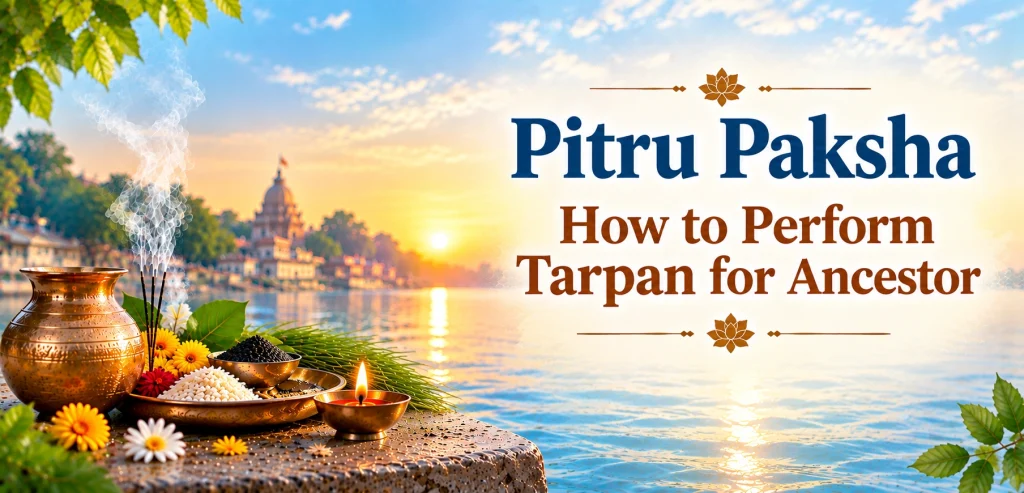
The word ‘Tarpana’ means “to satisfy” or “to please.” The tradition of offering water with devotion to the ancestors is called Tarpana. Water mixed with black sesame seeds (kale til) and kusha grass is offered while remembering the ancestors.
While performing Tarpana, not only the external ritual but also the inner feeling of devotion is considered important. When a descendant remembers the names and gotra of the ancestors and expresses gratitude, the act becomes a sacred expression of reverence and remembrance.
Pitru Paksha reminds us that our life has progressed through the sacrifices, values, and good deeds of many ancestors. Therefore, remembering the ancestors and offering them reverence during these days is an important part of the Sanatan way of life.
The main materials required for Tarpana are pure water or Ganga water, black sesame seeds, kusha grass, barley (jau), unbroken rice (akshat), flowers, sandalwood paste, and a sacred vessel. Traditionally, vessels made of copper, bronze, or silver are used for Tarpana. Kusha grass holds special importance in ancestral rituals. Therefore, one should perform Tarpana while wearing kusha according to one’s family tradition.
It should also be remembered that there may be some variations in the methods of ancestral rituals across different families and regions. Hence, it is best to give priority to one’s own family customs (kulachar) and the guidance of a qualified priest or acharya.
During Pitru Paksha, Tarpana and Shradh are performed on the designated Shradh date of one’s ancestors. If the Shradh date of any ancestor is not known, or if for some reason the ritual cannot be performed on that day, then Tarpana and charity can be offered with devotion on Sarva Pitru Amavasya for all ancestors.
Tarpana should be performed during the Kutupa period, which falls around midday. It is also appropriate to follow the time prescribed according to one’s family tradition. If there is any doubt regarding the exact date and muhurta for the ancestral ritual, it is advisable to seek guidance from a learned acharya.
During Pitru Paksha, charity and service are also given special importance along with Tarpana. According to one’s capacity, donate food grains, clothes, fruits, dakshina, and necessary items. Feed Brahmins, the needy, and helpless people.
Perform gau-seva, support education, and help any needy family. Service performed in the memory of the ancestors connects our devotion with the welfare of society.
The Upanishads also give primacy to faith in the matter of charity:
shraddhaya deyam. ashraddhaya adeyam.
(श्रद्धया देयम्। अश्रद्धया अदेयम्।)
shriya deyam. hriya deyam.
(श्रिया देयम्। ह्रिया देयम्।)
(भिया देयम्। संविदा देयम्॥)
— Taittiriya Upanishad, Shiksha Valli 1.11.3
This means charity should be given with faith, not without faith. One should give according to one’s capacity, with generosity, humility, and the right feeling.
Therefore, the charity performed during Pitru Paksha is not merely the giving away of an object, but a sacred resolve of devotion, service, and gratitude.
During Pitru Paksha, pay special attention to the purity of mind, speech, and actions. Take sattvic food and stay away from foods considered forbidden according to one’s family tradition. Avoid anger, ego, harsh words, and unnecessary disputes.
Do not insult anyone and maintain compassion, restraint, and humility in your behavior. In these days, remembrance of God, contemplation of the ancestors, and acts of service deepen the feeling of devotion in life.
Pitru Paksha gives us the opportunity to reconnect with our roots. Even if our ancestors are not physically present among us today, their values, teachings, and life principles continue to live in our lives. Therefore, merely completing the ritual of Tarpana is not enough; imbibing the virtues of the ancestors in our own lives is the true tribute to them.
Feed a needy person in their name. Help someone who is helpless. Walk on the path of dharma and service. Carry forward the values in your family. This is what makes the remembrance of the ancestors meaningful.
Sanatan Dharma teaches us that the duties related to the gods and the ancestors should not be neglected. The following verse from the Taittiriya Upanishad reinforces this feeling:
Meaning: One should not be negligent in the duties related to the gods and the ancestors.
Therefore, in this sacred Pitru Paksha, remember your ancestors with devotion. Perform Tarpana according to the prescribed method, offer charity in their name, feed the needy, and pray to Lord Sri Hari for the peace of your family ancestors and the welfare of the family.

In the year 2026, Shradh Paksha (Pitru Paksha) will begin on 26 September 2026 and end on 10 October 2026 with Sarva Pitru Amavasya. During this sacred period, followers of Sanatan Dharma can perform Shradh, Tarpan and other rituals for their ancestors according to the respective tithi.

Bhadrapada Purnima 2026 falls on September 26. Discover its date, puja vidhi, vrat, Satyanarayan worship, Chandra Dev prayers, and the spiritual significance of charity and service.

Bhadrapada Amavasya holds special spiritual significance in the Hindu Panchang. This sacred day is considered highly auspicious for self-reflection, remembering ancestors, offering Tarpan, taking a holy bath, and performing charity.