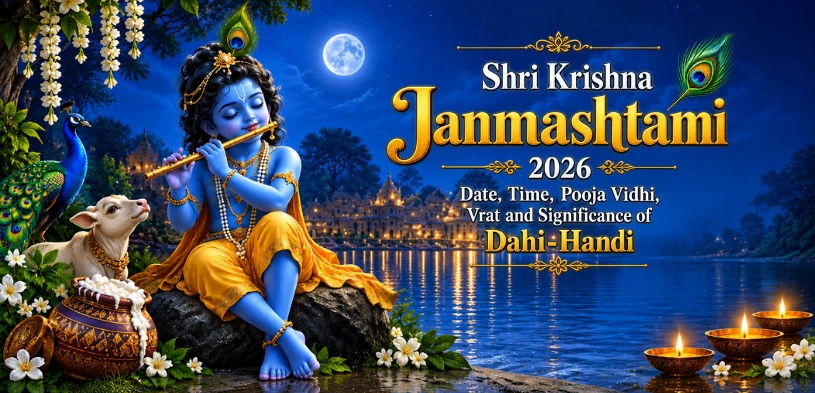
Shri Krishna Janmashtami is going to be celebrated on 4th Sep, 2026. If we talk about Nitish Puja muhurat is 11:57 PM – 12:43 AM. Whenever unrighteousness increases in the world, the Lord incarnates to protect righteousness and liberate devotees. In the Dwapara Yuga, when tyranny and unrighteousness reached their peak, Lord Vishnu incarnated as Shri Krishna and paved the way for the establishment of Dharma.
Lord Shri Krishna took birth on the Ashtami Tithi of the Krishna Paksha in the month of Bhadrapada, under the Rohini Nakshatra. Even today, millions of devotees observe His birth anniversary as a sacred occasion of faith and devotion.
Devotees celebrate Shri Krishna Janmashtami as the birth festival of Lord Shri Krishna. People also know it as Shri Krishna Janmotsav and Gokulashtami. On this day, Krishna temples across the country, including Mathura, Vrindavan, Gokul, and Dwarka, organize special prayers, bhajans, kirtans, and religious ceremonies.
In 2026, devotees will celebrate the sacred festival of Shri Krishna Janmashtami on Friday, September 4. On this day, devotees especially worship the child form of Lord Krishna, known as Laddu Gopal.
Janmashtami 2026 falls on Friday, September 4. Nishita Puja Muhurat: 11:57 PM – 12:43 AM on September 5. Devotees celebrate the divine birth of Lord Shri Krishna during this midnight period.
Devotees will break the Janmashtami fast after 6:01 AM on September 5, following the given fasting tradition and auspicious timing.
| Date | Friday, 4 September 2026 |
| Festival | Krishna Janmashtami |
| Nishita Puja | 11:57 PM – 12:43 AM (New Delhi) |
| Dahi Handi | Saturday, 5 September 2026 |
| Deity | Lord Krishna |
| Tithi | Krishna Paksha Ashtami |
Kans, the son of King Ugrasena of Mathura, married his sister Devaki to Vasudeva. After the wedding, as Kans was taking his sister to her husband’s home, a divine voice from the sky announced that Devaki’s eighth child would cause Kansa’s destruction.
Hearing this, Kans became frightened and imprisoned Devaki and Vasudeva. One by one, Kans killed Devaki’s children. However, when Devaki gave birth to Lord Shri Krishna as their eighth child, the prison doors opened on their own, and the guards fell into a deep sleep.
Vasudeva placed the newborn Shri Krishna in a basket and crossed the overflowing Yamuna to reach Gokul. In Gokul, Yashoda Ji gave birth to a daughter at the home of Nand Baba. Vasudeva placed Krishna beside Yashoda and brought the newborn girl back with him.
When Kansa tried to kill the girl, she transformed into Yogmaya and disappeared into the sky. Yogmaya warned Kansa that his destroyer had already taken birth.
Later, Nand and Yashoda lovingly raised Shri Krishna in Gokul as their own son.
Shri Krishna is a symbol of love, compassion, wisdom, and righteousness. In his childhood form, people know him as the playful Kanha and the beloved of the Gopis. On the battlefield of Kurukshetra, he became Arjuna’s charioteer and imparted the teachings of Dharma and Karma to him.
Through the Shrimad Bhagavad Gita, Lord Shri Krishna showed humanity the path of Karma, devotion, and righteousness. His message teaches that one should never turn away from one’s duties and should continue performing righteous actions without worrying about the results.
Therefore, Janmashtami is not only a celebration of Lord Krishna’s birth but also an opportunity to bring his divine teachings into our lives.
| Event | Date & Time |
|---|---|
| Ashtami Tithi Begins | 10:48 AM, 4 September 2026 |
| Ashtami Tithi Ends | 11:23 AM, 5 September 2026 |
| Rohini Nakshatra | Active during part of the Ashtami window |
| Nishita Puja Muhurat | 11:57 PM (4 Sept) – 12:43 AM (5 Sept) |
| Parana (Fast-breaking) Time | After 6:01 AM, 5 September 2026 |
Devotees observe the Janmashtami fast with faith and devotion toward Lord Shri Krishna. This festival comes after Raksha Bandhan. To observe the fast, devotees should take a bath in the morning, wear clean clothes, remember Lord Shri Krishna, and take a vow to observe the fast.
Devotees should choose the type of fast according to their health and personal capacity. Those who can manage a waterless fast may do so, while others may observe a fruit-based or sattvic fast.
Following religious tradition, devotees generally avoid grains and regular meals during the fast. Throughout the day, devotees can chant Lord Krishna’s name or listen to Krishna bhajans and kirtans.
In the evening, devotees should take a bath and prepare for the Janmashtami Puja. At midnight, after the birth of Lord Shri Krishna, devotees perform the Puja, Abhishek and Aarti and offer Bhog.
Afterward, devotees should break the fast according to their fasting tradition and the Parana time mentioned in the local Panchang.
While breaking the fast, devotees can accept the Lord’s Prasad and, if possible, offer food or donations to someone in need as an expression of their devotion.
On Janmashtami, devotees worship the child form of Lord Shri Krishna, known as Laddu Gopal. Tradition holds that Lord Krishna took birth at midnight, which is why devotees traditionally perform the birth celebration and special Puja around midnight.
The Puja Vidhi is as follows:
Decorate the Puja Area: Place a yellow or red cloth on a wooden platform and place Laddu Gopal. You can also prepare a beautiful flower-decorated swing for the Lord.
Bathe Bal Gopal: During the midnight Puja, first bathe Lord Shri Krishna with Panchamrit. Devotees traditionally prepare Panchamrit using milk, curd, ghee, honey, and sugar. After this, bathe the deity with Gangajal.
Perform Shringar: Dress the Lord in new and clean clothes. Apply sandalwood, roli, and Akshat as Tilak. Offer a peacock feather, flute, and Tulsi leaves to the Lord.
Offer Bhog: Offer Makhan-Mishri, Dhaniya Panjiri, fruits, sweets, and other sattvic dishes to Laddu Gopal. Add Tulsi leaves to the Bhog as well.
Celebrate the Birth at Midnight: At around midnight, welcome Lord Shri Krishna by blowing the conch and ringing bells. Gently swing Bal Gopal in the cradle and celebrate Krishna’s birth with bhajans and kirtans.
Perform Aarti: Light a lamp and incense and perform Lord Shri Krishna’s Aarti. Finally, pray to the Lord for the happiness, peace, and prosperity of the family and for the welfare of the entire world.
Among Lord Krishna’s childhood pastimes, his playful act of stealing butter stands out as especially charming. Bal Gopal loved butter and curd. Along with his friends, he would steal butter from the homes of the Gopis. Because of this, devotees lovingly called him “Makhan Chor,” or the butter thief.
Communities organize the Dahi Handi celebration during Janmashtami to commemorate this beloved childhood pastime of Lord Krishna.
People celebrate this tradition with great enthusiasm especially in Maharashtra and Goa. Organizers hang a pot filled with curd or butter at a height, and groups of young people form human pyramids to try to break it.
With the joyful chant of “Govinda Ala Re,” devotion to Lord Krishna fills the entire atmosphere.
| City | Nishita Puja |
|---|---|
| New Delhi | 11:57 PM – 12:43 AM |
| Gurgaon | 11:58 PM – 12:44 AM |
| Mumbai | 12:14 AM – 1:01 AM |
| Jaipur | 12:03 AM – 12:49 AM |
| Noida | 11:57 PM – 12:42 AM |
| Bengaluru | 11:55 PM – 12:42 AM |
Mathura and Vrindavan, the sacred places associated with the life and childhood of Lord Krishna, celebrate Janmashtami with extraordinary devotion and enthusiasm. People beautifully decorate temples, homes, and streets with flowers, lights, and colorful displays depicting episodes from Krishna’s life.
In Mathura, devotees gather at temples to participate in special prayers, devotional singing, and religious ceremonies. The Shri Krishna Janmabhoomi Temple hosts elaborate celebrations, with devotees observing fasts and gathering for the midnight rituals that commemorate the divine birth of Lord Krishna.
In Vrindavan, bhajans, kirtans, Jhankis, and special temple rituals mark the celebrations. Temples such as Banke Bihari and other prominent Krishna temples attract devotees from across India and beyond. The atmosphere becomes especially vibrant around midnight, when devotees celebrate Krishna’s birth with prayers, bells, chants, and devotional music.
Janmashtami in Mathura and Vrindavan is more than a religious festival—it is a celebration of faith, devotion, compassion, and the timeless message of Lord Krishna. The festival inspires devotees to embrace love, kindness, selfless service, and devotion in their daily lives.
Hindu scriptures and Indian religious traditions have always regarded charity and service as virtuous acts. Lord Shri Krishna also emphasized compassion and selfless service in human life.
Therefore, helping people in need on the sacred occasion of Janmashtami can be a beautiful way of expressing devotion to the Lord.
On this day, you can provide meals to needy families, support people who are helpless, or make an effort to bring happiness into the lives of those in need. Devotees consider such acts of compassion spiritually meaningful.
You can experience the divine not only inside temples but also through serving people who need our support.
Janmashtami reminds us that whenever unrighteousness and darkness increase in life, the light of divine grace eventually appears. The life of Lord Shri Krishna teaches us that there is strength in love, victory in righteousness, and that selfless action makes life meaningful.
This Janmashtami, let us resolve to make the message of love and Dharma a part of our lives.
Welcome Laddu Gopal into your home, remember the name of Lord Krishna, serve those in need, and let go of our ego, anger, and negativity while lighting the lamp of love and humanity within.
And finally, while paying obeisance at the feet of Shri Krishna:
Krishnaya Vasudevaya Haraye Paramatmane.
Pranatah Kleshanashaya Govindaya Namo Namah.
Q. When is Janmashtami 2026 in India?
A. Shri Krishna Janmashtami will be celebrated on Friday, 4 September 2026, as per the Hindu Panchang. It falls on the Ashtami Tithi of Krishna Paksha in the month of Bhadrapada.
Q. Is Janmashtami on 4th or 5th September 2026?
A. Janmashtami 2026 will be observed on Friday, 4 September 2026. The Krishna Paksha Ashtami Tithi begins on 4 September and continues into 5 September, but the main Janmashtami observance and midnight birth celebration fall on 4 September.
Q. What is Nishita Puja Muhurat for Janmashtami 2026?
A. The Nishita Puja Muhurat is from 11:57 PM on 4 September to 12:43 AM on 5 September 2026 (timings for New Delhi; they vary slightly by city). This midnight window is considered the most auspicious time to perform the birth celebration of Lord Krishna.
Q. Why is Janmashtami celebrated at midnight?
A. According to Hindu scriptures, Lord Krishna was born at midnight (Nishita Kaal) under the Rohini Nakshatra, in the prison cell of Kansa. Since his divine birth took place at this hour, devotees perform the main Puja, Abhishek, and Aarti at midnight to mark the exact moment of his arrival.
Q. Is fasting compulsory on Janmashtami?
A. No, fasting is a matter of personal faith and capacity, not a compulsory rule. Devotees may keep a strict waterless (nirjala) fast, a fruit-based (phalahar) fast, or a single sattvic meal, depending on their health. The fast is traditionally broken after the midnight Puja or the next morning at the Parana time mentioned in the local Panchang.
Q. What is Dahi Handi, and when is it celebrated in 2026?
A. Dahi Handi is a tradition that commemorates Lord Krishna’s childhood pastime of stealing butter and curd, which earned him the name “Makhan Chor.” A pot of curd or butter is hung at a height, and groups form human pyramids to break it, accompanied by the chant “Govinda Ala Re.” In 2026, Dahi Handi will be celebrated on Saturday, 5 September, the day after Janmashtami. It is observed with special enthusiasm in Maharashtra and Goa.
Q. What is the significance of Vrindavan and Gokul on Janmashtami?
A. Gokul is where Krishna was raised by Nand Baba and Yashoda after his birth in Mathura, while Vrindavan is where he later spent his childhood performing his most cherished Leelas, such as the Raas Leela and lifting Govardhan Parvat. Both places are inseparable from Krishna’s identity and devotion to him. On Janmashtami, temples in Vrindavan and Gokul, including Banke Bihari Temple, witness some of the grandest celebrations in the country, drawing lakhs of devotees.
Jai Shri Krishna!
On Papankusha Ekadashi, traditions of worshipping Lord Vishnu, fasting, chanting His name, listening to religious stories, night vigil, and charity have been followed. This day provides an opportunity to light the lamp of devotion and spirituality within oneself.
In 2026, Shardiya Navratri begins on Sunday, October 11. This year, the belief that Maa Durga arrives riding an elephant is receiving special attention. Devotees worship the Goddess in her Gajvahini form and pray for happiness, peace, and prosperity in their lives.
Shardiya Navratri 2026 begins 11 October with Ghatasthapana and concludes with Dussehra on 20 October. Get the full Ghatasthapana Muhurat, day-wise Durga Puja calendar, colours, and puja vidhi inside.