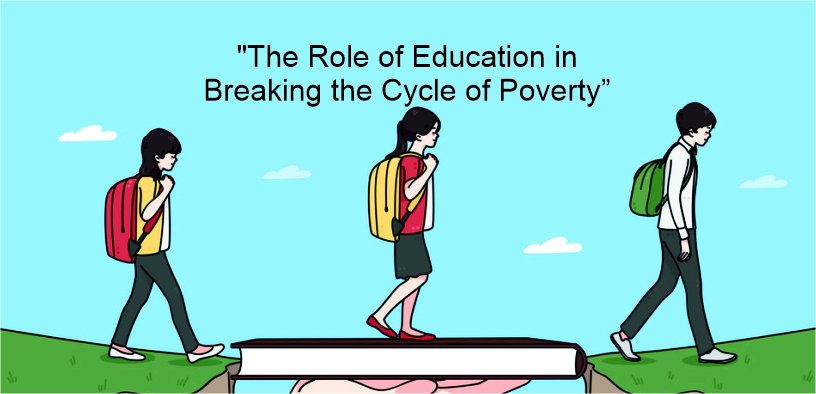
The roots of education are bitter, but the fruit is sweet.” These words were spoken by the ancient philosopher Aristotle. They reflect the transformative power of education. This sentiment resonates profoundly even in our modern society.
Education serves as the cornerstone of individual and societal progress. It not only equips people with skills and knowledge. It also fosters personal growth and paves the way for enlightened, responsible citizenship.
In a developing country like India, poverty remains a stark reality for many. Here, education holds the key to disrupting the stubborn cycle of impoverishment.
Community-based organizations like Narayan Seva Sansthan are playing a commendable role in promoting education. However, the fight against poverty necessitates collective efforts from various societal sectors.
This article explores the indispensable role of education in breaking the poverty cycle. It discusses how its potential can be fully realized in the Indian context.
For poverty to end, several variables or events must come together unless there is outside intervention. This is known as the poverty cycle.
In India, children born into poverty often lack access to quality education and nutritious food. They also lack healthcare. This limits their potential and perpetuates their circumstances into adulthood.
They grow up with fewer skills. They are likely to find low-paying jobs. This traps them and their future generations in a cycle of poverty.
Education empowers individuals. It allows them to break free from the shackles of poverty. It enhances skills and improves employability. It also opens doors to better economic opportunities.
More importantly, education fosters critical thinking. It promotes social and political participation. It nurtures the principles of equality and justice. This facilitates holistic human development.
The path to education in India is fraught with numerous obstacles despite its significance. Poverty is a significant deterrent. Families are often unable to afford the direct and indirect costs of schooling.
Moreover, social discrimination and gender biases impede access to quality education. Poor infrastructure, particularly in rural areas, is another barrier. These barriers must be addressed. This ensures that education serves as an effective instrument for poverty alleviation.
The government plays a pivotal role in promoting education. India’s Right to Education Act mandates free and compulsory education for children aged 6-14. This is a step in the right direction.
Other initiatives include the Mid-Day Meal Scheme. This incentivizes school attendance by providing meals. The Beti Bachao, Beti Padhao campaign is another example. It focuses on promoting girl child education. However, implementation issues and lack of sufficient funding still need to be addressed. Low-quality education also remains a concern.
Non-governmental organizations (NGOs) and community-based organizations play a crucial role. They complement government efforts to promote education. They work at the grassroots level and understand local contexts. They can provide customized solutions to unique challenges.
Among these organizations, the Narayan Seva Sansthan (NSS) is a shining beacon of hope. It is primarily known for providing free surgeries for the differently-abled. However, the NSS also actively contributes to education for the underprivileged.
Through initiatives like free coaching, it offers educational support. This helps children from economically disadvantaged backgrounds. It helps break the cycle of poverty.
Education must be a potent tool in breaking the cycle of poverty. A multi-pronged approach is necessary for this. This includes improving the quality of education and bridging the urban-rural divide. We must also enhance the gender balance and make education more inclusive.
Merely enrolling children in schools is not enough. The quality of education plays a significant role in shaping a child’s prospects. Teachers must be well-trained. Curricula must be relevant. The learning environment should stimulate creativity and critical thinking.
Rural areas in India often suffer from poor educational infrastructure. They face a shortage of teachers and high dropout rates. Addressing these issues is vital. It ensures that rural children are not left behind.
This could involve investing in infrastructure. It could include providing incentives to attract teachers to rural areas. Flexible schooling options can cater to children engaged in family occupations or agriculture.
Girls often face higher barriers to education. These include safety concerns and domestic responsibilities. Societal prejudices are also a factor. Ensuring gender balance in education is critical. This involves creating safe and girl-friendly school environments. We must promote gender sensitivity and encourage the active participation of girls.
Inclusive education ensures that all children have access to quality education. This applies regardless of their socioeconomic background, caste, religion, or ability. This is especially crucial in a varied nation like India.
Inclusive education can be promoted by implementing anti-discrimination policies. Providing scholarships for disadvantaged students is also important. We must promote the inclusion of differently-abled children in regular schools.
Education is a potent tool to break the cycle of poverty. However, leveraging this tool requires collective efforts. This involves the government, NGOs, and community-based organizations. Society at large must also participate.
The work of organizations like the Narayan Seva Sansthan demonstrates this. A concerted effort can make a significant difference in the lives of the underprivileged. Let us all work towards an India where every child has the chance to learn. Every child deserves to grow and break free from the clutches of poverty.
1. How does education contribute to breaking the cycle of poverty?
Education helps break the cycle of poverty by enhancing individuals’ skills. It improves their employability. It provides them access to better economic opportunities.
It also encourages critical thinking. It nurtures principles of equality and justice. These help individuals overcome societal barriers and improve their living conditions.
Education has a positive impact on health outcomes. It can lead to more informed decision-making. Both factors contribute to poverty reduction.
2. What are the major barriers to education in India, and how can they be addressed?
Major barriers to education in India include financial constraints and social discrimination. Gender biases and inadequate infrastructure are also factors.
Addressing these requires a multifaceted approach. We must improve school infrastructure. Providing financial assistance for disadvantaged families is key. We should also promote gender equality and implement anti-discrimination policies.