Raksha Bhandan is holy festival of brother and sister love. It is celebrated all around the India. This festival beautifully express the depth of relationships and the values of life. Celebrated on the full moon day of the holy Shravan Mass, this festival symbolizes the love, trust, and mutual devotion between brothers and sisters. When a sister ties a rakhi around her brother’s wrist, that simple thread carries feelings of love, blessings, and good wishes.
In 2026, Raksha Bandhan will be observed on 28 August. Along with the festival date, devotees may have questions about the Rakhi tying time, Bhadra, lunar eclipse, Sutak period and auspicious rituals. Here is everything you need to know about Raksha Bandhan 2026.
In 2026, Raksha Bandhan will be celebrated on Friday, August 28. On this day, sisters will perform the traditional rituals and tie rakhi on their brothers’ wrists while praying for their happiness, good health, prosperity, and well-being.
Auspicious Muhurat for Tying Rakhi: 6:19 AM to 9:48 AM
Total Duration: 3 hours 28 minutes
The word “Raksha Bandhan” itself conveys the essence of the festival, combining the meanings of “protection” and “bond.” In Indian tradition, a rakhi is considered a symbol of love and goodwill.
While tying the rakhi, a sister prays for her brother’s long life, happiness, prosperity, and success. The brother, in turn, promises to stand by his sister with love and respect and to protect and support her.
Thus, rakhi symbolizes a bond of trust that strengthens the relationship between two hearts.
The tradition of tying a sacred protective thread is believed to be very ancient in Indian religious traditions. Sacred threads have also been tied during yajnas, pujas, and other religious rituals.
This is why Raksha Bandhan is also closely connected with India’s spiritual and cultural heritage.
A partial lunar eclipse will occur on 28 August 2026. However, this astronomical event will not be visible from India because the Moon will be below the horizon during the relevant phases of the eclipse.
The eclipse will be visible from several parts of the world, particularly across regions of the Americas and other areas where the Moon is above the horizon.
Since the eclipse will not be visible in India, traditional religious practices generally do not consider the associated Sutak period applicable here.
Bhadra is another important factor traditionally considered while deciding the appropriate time for Rakhi tying.
In 2026, Bhadra will end on 27 August, before Raksha Bandhan is celebrated on 28 August. Therefore, there will be no Bhadra-related restriction during the morning Rakhi ceremony on the festival day.
According to Hindu traditions, many people avoid tying Rakhi during Bhadra. With Bhadra ending a day earlier, the morning of Raksha Bandhan remains suitable for performing the customary rituals.
| Event | Details |
|---|---|
| Festival | Raksha Bandhan 2026 |
| Date | 28 August 2026 |
| Day | Friday |
| Tithi | Shravan Purnima |
| Rakhi Tying Time | 6:19 AM to 9:48 AM* |
| Lunar Eclipse | Partial Lunar Eclipse |
| Eclipse Visible in India | No |
| Sutak in India | Not considered applicable due to non-visibility |
| Bhadra | Ends on 27 August 2026 |
* Rakhi Muhurat is based on Panchang and may vary according to the location.
Among the religious legends associated with Raksha Bandhan, the story of Lord Vishnu and King Bali holds special significance.
According to the legend, Lord Vishnu took the form of Vamana and asked King Bali for three steps of land. With His divine form, Lord Vishnu covered the entire earth and sky in two steps. For the third step, King Bali offered his own head at the Lord’s feet.
Pleased with his devotion and surrender, Lord Vishnu made him the ruler of the netherworld and promised to stay with him.
When Goddess Lakshmi came to know that Lord Vishnu was residing in the netherworld, she accepted King Bali as her brother and tied a sacred protective thread around his wrist. King Bali also accepted her as his sister and, respecting her wish, allowed Lord Vishnu to return to Vaikuntha with her.
On the day of Raksha Bandhan, take a bath in the morning and wear clean clothes. Clean the place of worship and remember the divine. Then prepare a puja thali with roli, akshat, a lamp, sweets, and rakhi.
First, worship the Lord. Ask your brother to sit comfortably in an auspicious place. Apply a tilak of roli or sandalwood paste to his forehead and offer akshat. Then perform his aarti with the lamp and respectfully tie the rakhi around his wrist. Offer him sweets and pray for his happiness and well-being.
The brother should also express his love and blessings and take a sincere pledge to always stand by his sister, respect her, and support her.
While tying the rakhi, the following mantra may be recited:
“Yena Baddho Bali Raja, Danavendro Mahabalah.
Tena Tvamapi Badhnami, Rakshe Ma Chala Ma Chala.”
This mantra recalls the sacred protective thread associated with King Bali and expresses a prayer for protection, stability, and well-being. In religious tradition, chanting sacred mantras is considered a way of strengthening an auspicious intention.
While choosing a rakhi, its emotional and spiritual significance should be given as much importance as its appearance. A traditional rakhi made from mouli or cotton thread is considered a symbol of simplicity and religious devotion. Rakhis featuring auspicious religious symbols such as Om, Swastik, and Trishul are also associated with Indian culture and faith.
Rakhis made with elements such as Rudraksha or Tulsi also express spiritual devotion. However, the true significance of a rakhi does not lie in its price or decoration, but in the love and good wishes behind it. A simple thread tied with a sincere heart can be priceless for a relationship.
Raksha Bandhan is celebrated throughout India, but the way people observe the festival can be quite different from one region to another. The emotions remain the same, while local customs, food, rituals, and family traditions give the festival its own regional flavour.
In Rajasthan and Gujarat, families celebrate the day with traditional puja, colourful rakhis, sweets, and family gatherings. In some communities, the Lumba Rakhi tradition is also followed, where a rakhi is tied to the brother’s wife, reflecting the importance of relationships within the entire family.
In Maharashtra, Raksha Bandhan is closely associated with Narali Purnima, especially among coastal communities. People offer coconuts to the sea as a traditional prayer for safety and prosperity. Alongside these regional customs, siblings also celebrate their special bond through the usual Rakhi rituals.
Across Uttar Pradesh, Bihar, Delhi, Punjab, and Haryana, the festival is often marked by tilak, aarti, rakhi tying, sweets, gifts, and blessings from elders. For many families, it is also a time to return home, meet relatives, and spend meaningful time together.
In West Bengal and Odisha, the festival carries a broader message of affection, harmony, and togetherness. Along with family celebrations, the tradition of tying sacred threads is observed in different communities as a symbol of goodwill and strong relationships.
In Karnataka, Tamil Nadu, Telangana, Andhra Pradesh, and Kerala, Raksha Bandhan is celebrated by families with their own regional customs. Since the festival falls on the full moon of Shravan, it may also coincide with other local religious observances, adding to the spiritual atmosphere of the day.
From one state to another, the rituals may change, but the heart of Raksha Bandhan remains unchanged. Whether celebrated with a simple rakhi at home or as part of a larger family gathering, the festival reminds us to value love, trust, respect, care, and the relationships that stay with us through every stage of life.
Times are changing, life is becoming increasingly busy, and family members often live far away from one another. In such circumstances, Raksha Bandhan gives us an opportunity to reconnect with our relationships.
It brings back childhood memories and reminds us that no matter how circumstances change, the bond of love and belonging should never become weak.
If this feeling is extended beyond the boundaries of our families, the message of Raksha Bandhan becomes even more meaningful. There are many people in society who need support, respect, care, and assistance.
Helping someone in need, bringing the light of self-reliance into the life of a person with disabilities, or bringing a smile to the face of an underprivileged family—these too are meaningful forms of protection, care, and well-being.
Wishing you all a very Happy Raksha Bandhan filled with love, happiness, and auspicious blessings.
Q. When is Raksha Bandhan in 2026
A. Raksha Bandhan will be celebrated on 28 August 2026, which falls on Friday.
Q. What is the Rakhi tying time on Raksha Bandhan 2026?
A. According to the Delhi Panchang, Rakhi can be tied between 6:19 AM to 9:48 AM on 28 August 2026. Local timings may differ.
Q. Will the lunar eclipse be visible in India on 28 August 2026?
A. No. The lunar eclipse will not be visible from India because the Moon will be below the horizon during the relevant eclipse phases.
Q. Will Sutak apply in India for the August 2026 lunar eclipse?
A. Since the eclipse will not be visible from India, traditional religious observances generally do not consider Sutak applicable in the country.
Q. Is there Bhadra on Raksha Bandhan 2026?
A. Bhadra will end on 27 August 2026, so it will not create a Bhadra restriction for the morning Rakhi ceremony on 28 August.
Q. Can Rakhi be tied during the lunar eclipse?
A. For celebrations in India, the eclipse will not be visible, so it does not create an eclipse-related restriction on Rakhi tying. Devotees should follow their local Panchang and family traditions.
The last day of Pitru Paksha is known as Sarva Pitru Amavasya. This Amavasya is considered especially significant for remembering all known and unknown ancestors whose Shradh date may not be known or whose Shradh could not be performed on the prescribed tithi for some reason.
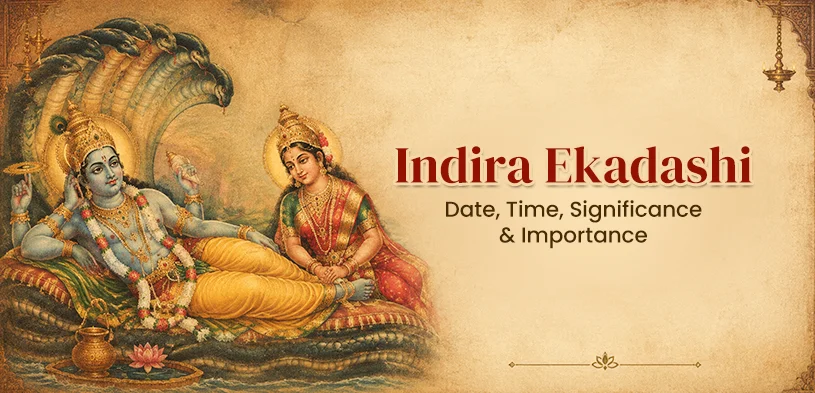
Indira Ekadashi, which falls during the Krishna Paksha of the Ashwin month, is one such meritorious tithi. As it occurs during Pitru Paksha, this day is specially associated with the worship of Lord Vishnu along with feelings of reverence and righteous deeds.
Our ancestors laid the foundation of the family through their lives, austerities, values, and good deeds. Pitru Paksha is the sacred opportunity to express reverence and gratitude towards them.