- +91-7023509999
- 0294-6622222
- info@narayanseva.org
In Indian culture, every festival symbolizes both celebration and spiritual message and a philosophy of life. Holi is one such sacred festival, considered a wonderful confluence of colors, joy, and devotion. Celebrated on the full moon day of the month of Phalgun, this festival is not merely a celebration of external colors, but an opportunity to color the inner self with love, compassion, and harmony.
This year, a lunar eclipse is going to occur on March 3rd. Therefore, the biggest question is when will the colors be played? According to astrology, the Sutak period begins nine hours before the lunar eclipse. During the Sutak period, any religious celebrations are avoided. Therefore, the festival of colors will be celebrated on March 4th, 2026. If we consider the scriptures, colors can be played after the eclipse ends. Therefore, Dhulandi will be celebrated on March 4th.
According to the almanac, this time a lunar eclipse will also occur along with Holi, which will be visible in India. Therefore, the eclipse’s Sutak period will also be in effect throughout India. According to Indian Standard Time, the lunar eclipse will begin on March 3rd at 3:20 pm and end at 6:47 pm. The total duration of this lunar eclipse will be visible for 3 hours and 27 minutes.
Holi is closely linked to the story of devotee Prahlad and his father, Hiranyakashipu. Hiranyakashipu was a demon king who, in his arrogance, declared himself God. However, his son Prahlad was an ardent devotee of Lord Vishnu. Despite numerous tortures, Prahlad’s devotion remained unwavering. Ultimately, Hiranyakashipu’s sister Holika, who had the boon of not being burned by fire, sat in the fire with Prahlad in her lap.
However, in a divine act of justice, Holika was burned to ashes, while Prahlad remained unharmed. Holika Dahan is celebrated in this memory. This burning isn’t just of wood, cow dung cakes, and sticks, but also of ego, anger, jealousy, and sinful tendencies.
Holi of Colors is played on the second day of Holika Dahan. This day symbolizes social harmony and mutual love. Discarding all differences of age, age, rich and poor, caste and creed, everyone applies colors to each other. Holi holds special significance in the Braj region in the Sanatan tradition. The Lathmar Holi of Vrindavan and Barsana is world-famous. Holi here commemorates the divine pastimes of Radha and Krishna, which are still alive today in the streets of Braj and throughout India.
Holi is not only a festival of colors but also a festival of delicacies and sweets. A variety of sweets and dishes are prepared in every household during this festival. Let’s learn about some of the special dishes prepared on Holi:
Gujiya: Gujhiya is a special dish, without which the festival of Holi remains incomplete. This dish is prepared in almost every household in India, and people love to eat and share Gujhiya with Holi colors.
Dahi Bade: Dahi Bade is a special Holi dish, without which Holi seems incomplete. This dish is especially prepared in the homes of Braj during the festival.
Gulab Jamun: Gulab Jamun is a famous Indian sweet, without which the festival becomes dull, hence this sweet is included in the Holi celebrations in every household. Family members eat this sweet with great relish and also serve Gulab Jamun to guests who come for Holi celebrations.
In addition to these sweets and dishes, Gathiya, salty Puris, and Malpuas also enhance the flavor of this festival.
In today’s times, while celebrating Holi, we should also be mindful of the environment. Use natural and herbal colors instead of chemical dyes. Conserve water and make Holi pure, dignified, and joyful.
Holi is not just a festival of colors but a festival of self-purification and love. No matter how difficult the circumstances in life, if we have the light of devotion and truth in our hearts, no Holika can burn us. On this auspicious occasion, offer your innermost evil to Holika and illuminate your life with the colors of love, forgiveness, and harmony.
Frequently Asked Questions (FAQs)
Question: When is Holi?
Answer: Holi will be celebrated on March 4th.
Question: When is the lunar eclipse?
Answer: The lunar eclipse is going to occur on March 3rd, 2026.
Question: What is the lunar eclipse time?
Answer: The lunar eclipse will occur on March 3rd, 2026, from 3:20 pm to 6:47 pm.
Question: When is Dhulandi?
Answer: Dhulandi or the festival of colors will be celebrated on March 4th.
फाल्गुन पूर्णिमा 2026 में एक विशेष महत्व रखती है, क्योंकि इस दिन चंद्र ग्रहण भी पड़ रहा है। यह पूर्णिमा तिथि 2 मार्च 2026 को शाम 5:55 बजे से शुरू होकर 3 मार्च 2026 को शाम 5:07 बजे तक रहेगी।
फाल्गुन पूर्णिमा 2026 में एक विशेष महत्व रखती है, क्योंकि इस दिन चंद्र ग्रहण भी पड़ रहा है। यह पूर्णिमा तिथि 2 मार्च 2026 को शाम 5:55 बजे से शुरू होकर 3 मार्च 2026 को शाम 5:07 बजे तक रहेगी।
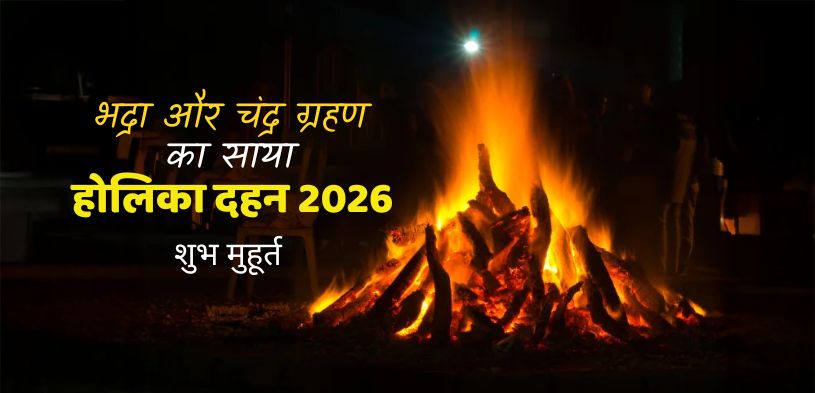
होलिका दहन भारतीय संस्कृति का पवित्र पर्व है, जो अधर्म पर धर्म की विजय का प्रतीक है। 2026 में 3 मार्च को चंद्र ग्रहण के साथ मनाया जाएगा, जहां भक्त नकारात्मकता को अग्नि में समर्पित कर आत्मशुद्धि का संकल्प लेंगे।