- +91-7023509999
- 0294-6622222
- info@narayanseva.org
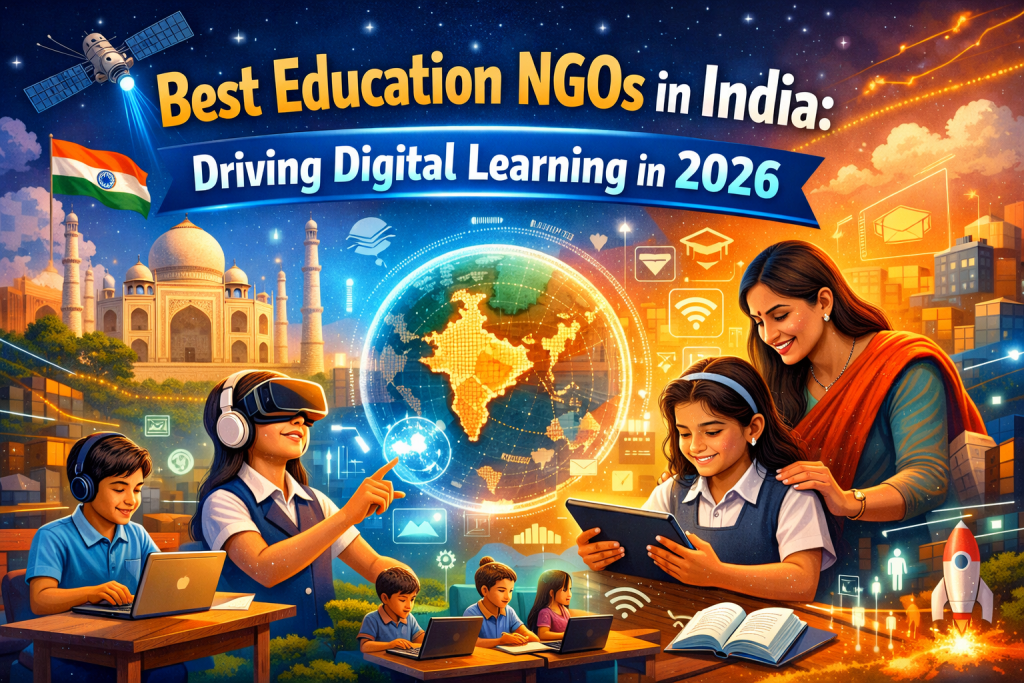
In 2026, digital learning in India is no longer a luxury. It has become a necessity. Technology is transforming education across the country. It affects how students learn in both major cities and remote villages. It also influences how teachers teach and how communities stay connected with schools.
Nonprofits and NGOs are playing an important role in making digital education accessible to underprivileged and differently-abled children.
While government programs provide some support, many education NGOs in India are independently working to close the learning gap. They improve access through smart classrooms, digital learning content, teacher training, and community engagement.
India has one of the largest student populations in the world. Digital learning has now become a powerful tool for democratizing quality education. More than 260 million students still face difficulties in accessing consistent learning opportunities.
In many rural and remote areas, poor infrastructure remains a major challenge. Limited road connectivity, a shortage of trained teachers, and lack of educational resources often prevent students from receiving quality education.
Digital learning platforms help address these challenges. They provide personalized AI-based learning, engaging visual content, and structured curriculum support.
These tools also assist students with disabilities and expand quality education to remote communities. Today, NGOs play a critical role in driving digital transformation at the grassroots level.
Not every NGO succeeds in implementing digital learning initiatives. The most effective organisations in 2026 share several important characteristics.
Successful NGOs use technology designed for low-resource environments. They adopt tools that function with low bandwidth and often work offline. This approach makes digital learning possible in areas with limited or unstable internet connectivity.
Effective organisations go beyond distributing tablets or devices. They train local teachers, volunteers, and parents to support digital education. This creates a sustainable learning system driven by the community itself.
Leading NGOs design digital tools that support children with disabilities and first-generation learners. Their goal is simple: ensure that no child is excluded from quality education.
Successful models can expand easily. These initiatives integrate with the existing government school ecosystem. This makes large-scale implementation both sustainable and cost-effective.
Pratham has long been a leader in education innovation in India. In 2026, the organisation continues to expand its Hybrid Learning model.
This model combines low-cost tablets with community-led digital learning hubs. As a result, learning extends beyond the traditional classroom.
Through its education initiatives and vocational training programs, the organization provides computer literacy, skill-based digital training, and accessible e-learning modules.
By combining education, rehabilitation, and technology, Narayan Seva Sansthan ensures that no child is left behind in India’s digital learning revolution.
Narayan Seva Sansthan integrates digital learning with inclusive education for unprivileged children.
In 2026, the organization is expanding smart classrooms equipped with assistive technologies, digital boards, and adaptive learning tools designed for children with physical disabilities.
The organization also offers digital content in multiple regional languages. This approach allows children to learn in ways that are comfortable and familiar to them. It also helps reduce dropout rates in rural communities.
Teach For India is widely known for its human-focused Fellowship model. In 2026, the organisation places strong emphasis on technology-enabled leadership. Fellows use advanced data analytics to track student progress and implement blended learning programs.
The 2026 fellowship cohort uses modern digital tools that combine innovative teaching methods with the needs of underserved urban and rural communities.
The Azim Premji Foundation focuses on empowering teachers as the foundation of digital transformation. Its initiatives in states such as Jharkhand have already digitised fieldwork for more than 1,200 educators.
Azim Premji University also continues to prepare future education professionals. These educators receive training in digital assessments, teaching technology, and early childhood education systems.
NIIT Foundation believes that digital literacy should be accessible to everyone. One of its key initiatives is the “Digital Bus.” This program delivers fully equipped mobile computer labs directly to rural communities.
The foundation also collaborates with industry partners. Together they align digital education with real job market needs. Training focuses on practical skills such as data entry, graphic design, and IT support.
Smile Foundation runs the “Shiksha Na Ruke” initiative, which means Education Must Not Stop. This program provides students with tablets containing preloaded educational content. It also delivers lessons through radio and offers mental health support helplines.
By combining digital education with emotional well-being programs, the foundation helps underprivileged children stay connected to learning.
Today, many rural government schools are beginning to adopt digital technology. In some classrooms, bright digital screens have replaced traditional chalkboards. More importantly, students are showing greater interest and excitement while learning.
For many years, student engagement remained a major challenge in rural education. Several villages lacked access to qualified teachers, especially for subjects such as mathematics and science.
Smart classroom technology is changing this situation. Expert-led lessons can now reach students in remote villages. This allows rural learners to access the same quality education available in urban schools.
What makes this transformation powerful is its human element. Organisations like Pratham and Narayan Seva Sansthan understand that technology works best when compassion and commitment guide its use.
By 2030, nearly half of India’s government schools are expected to adopt some form of smart classroom infrastructure. If current progress continues, dropout rates may decline while curiosity and participation increase.
Millions of children will gain access to better learning opportunities. The future of digital education in India is not a distant vision. It is already taking shape today.

The Hindu New Year 2026, Vikram Samvat 2083, begins on Chaitra Shukla Pratipada (the bright fortnight of the bright fortnight) on March 19, when Jupiter becomes king and Mars becomes minister in the Rudra Samvat.

International Women’s Day 2026 will be celebrated on March 8 with the theme “Give to Gain.” The year 2026 also marks 115 years of International Women’s Day, first celebrated in 1911. Learn about the history, significance, and global celebration of Women’s Day.

चैत्र अमावस्या 2026, जो 19 मार्च को पड़ रही है, प्रार्थना, व्रत और दान के ज़रिए पुरखों का सम्मान करने का एक पवित्र दिन है। इसके रीति-रिवाज़, आध्यात्मिक महत्व और दान के फ़ायदों के बारे में जानें।